
Foundational Dietary Concepts
Understanding the Principles Behind Thoughtful Eating
Nutritional science has produced a body of well-documented principles that describe how different approaches to eating influence the relationship between diet and general well-being. The following concepts are drawn from this body of knowledge and are presented here in an educational context, with the aim of explaining what each principle means rather than prescribing how any individual should eat.
Variety: The Structural Basis of Nutritional Coverage
Dietary variety is the practice of consuming a wide range of different foods across and within food groups over time. It is one of the most consistently cited structural principles in nutritional science, not because any single food is deficient, but because different foods contribute different combinations of nutrients.
No single whole food provides all the nutrients the human body requires in adequate amounts. By consuming a varied range of foods, the dietary pattern as a whole achieves a more complete nutritional profile than any narrower selection could provide.
- Different coloured vegetables and fruits each contain distinct phytonutrients not found in their counterparts of other colours.
- Varying protein sources exposes the diet to different amino acid profiles and associated micronutrients.
- A range of grain types provides different fibre compositions and mineral contents.
- Rotating oils and fat sources introduces a broader range of fatty acid types.

Moderation: Understanding Proportion in Dietary Patterns
Moderation, in a dietary context, refers to the principle that no single food or food type dominates the overall pattern to the exclusion of others. It is a relative and pattern-level concept, meaning it describes the relationship between different foods consumed over time rather than a judgement about any individual meal.
In dietary terms, moderation is less about restriction and more about balance across the whole pattern. Nutritional epidemiology consistently describes healthy dietary patterns as those in which no single macro- or micronutrient source occupies a disproportionate share of overall intake.

Balance: Distributing Nutrients Across Food Groups
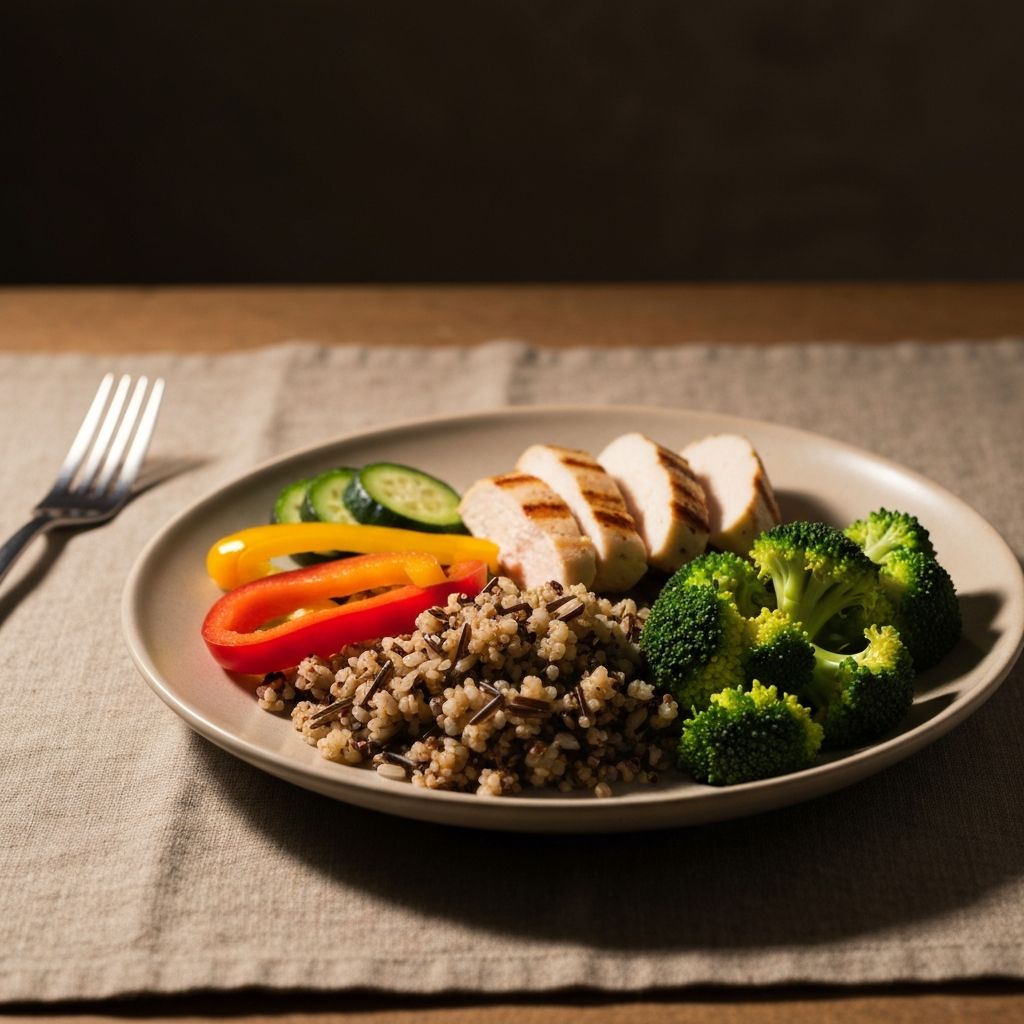
Balance refers to the representation of different food groups within the dietary pattern. A balanced diet, as described in most general nutritional frameworks, includes meaningful portions of grains, vegetables, fruits, protein sources, and fats, with none systematically absent or overwhelmingly dominant.
The concept of balance is important because different food groups provide nutrients that are not substantially replicated by others. Vegetables and fruits contribute certain vitamins, minerals, and fibre; grains provide carbohydrates and B vitamins; protein foods supply amino acids and minerals such as iron and zinc; dairy or alternatives contribute calcium and phosphorus.
Why Balance Is a Structural Concept
Balance does not prescribe the exact proportion of each group that any individual should consume. It describes the principle that all food groups contribute distinct and necessary nutrients, and that systematic exclusion of any group creates the potential for nutritional gaps over time. The specific proportions that constitute balance in practice are addressed differently across various national dietary guidelines.
Portion Awareness: Understanding Quantity in Dietary Context
Portion awareness refers to the capacity to recognise and understand the quantities of different foods being consumed in relation to their contribution to overall dietary intake. It is a descriptive concept, not a prescriptive one: the purpose of discussing portion sizes is to provide context for understanding nutritional information, not to set universal targets.
Nutritional label information, serving size references in dietary guidelines, and descriptions of food quantities in research contexts all rely on standardised portion definitions. Understanding what these definitions mean is useful for interpreting such information accurately.
Portion sizes as described in dietary guidelines are reference quantities, not behavioural mandates. They provide a standardised unit of measurement that allows for consistent communication about nutritional content.
How Portion References Are Used in Nutritional Communication
- Food labels list nutritional content per a defined serving size to enable comparison between products.
- Dietary guidelines use portion equivalents to describe the structural composition of different food pattern recommendations.
- Nutritional research uses standardised portion definitions to ensure consistency across studies and populations.
- Public health education uses portion visualisation to help individuals understand the relative scale of different foods in the context of a varied diet.
Mindful Eating: Attention and Awareness at Mealtimes
Mindful eating is a concept that describes the practice of bringing deliberate, focused attention to the experience of eating: the sensory qualities of food, the body's physical signals, and the environmental and social context of meals. It draws on principles from attentional psychology and has been studied in the context of dietary behaviour.
Mindful eating does not prescribe what to eat; it describes a quality of engagement with food. Research in this area examines how attentiveness during eating relates to patterns of food selection and consumption, rather than asserting that mindfulness produces specific nutritional outcomes.
Historically, many traditional food cultures incorporated practices structurally similar to mindful eating, including communal meals, extended meal durations, and rituals that emphasised the social and sensory dimensions of food rather than purely its functional role.
Cooking Methods and Nutritional Composition
The method by which food is prepared affects the nutritional composition of the final product. This is not a simple matter of one method being better than another; different preparation approaches affect different nutrients in different ways, and the overall impact depends on the specific food and the preparation conditions.
| Preparation Method | General Effect on Nutrients | Contextual Notes |
|---|---|---|
| Boiling / Simmering | Water-soluble vitamins (B and C) may leach into cooking water. Mineral content is largely retained in the food itself. | Using cooking liquid in soups or sauces retains some leached nutrients. Shorter cooking times reduce water-soluble vitamin loss. |
| Steaming | Water-soluble vitamins are better retained compared to boiling, as food does not contact the water directly. | Generally described as a method that preserves more of the water-soluble vitamin content of vegetables relative to submersion methods. |
| Roasting / Baking | Dry heat can reduce some heat-sensitive vitamins (particularly B and C). Maillard reactions change flavour compounds and create certain reactive molecules. | Mineral content is largely unaffected. Fat-soluble vitamins are comparatively stable under dry heat. |
| Frying (Pan or Deep) | Addition of fat changes the caloric density and fatty acid composition of the food. High temperatures affect some vitamins. | The type of fat used influences the fatty acid profile of the cooked food. Temperature control affects the extent of oxidation of cooking fats. |
| Raw Consumption | Heat-sensitive nutrients are fully retained. Some anti-nutritional factors (which can inhibit mineral absorption) may also be present and are not deactivated. | Cooking can increase the bioavailability of certain nutrients (such as lycopene in tomatoes and beta-carotene in carrots) despite reducing others. |
| Fermentation | Microbial activity can increase the bioavailability of certain minerals and synthesise B vitamins. May also reduce anti-nutritional factors. | A traditional food preservation and preparation method present across many global dietary traditions, with a distinct effect on food composition compared to heat-based methods. |